
Best Aluminum Alloys for CNC Machining: 6061 vs 6063 vs 6082 vs 7075
Choosing the right aluminum alloy for CNC machining shapes the performance, durability, and overall cost of your final part. This article explains the best aluminum alloys for CNC machining and helps you understand how 6061, 6063, 6082, and 7075 differ in real engineering scenarios.
Many engineers and procurement teams struggle with material selection because every alloy behaves differently during cutting, finishing, and long-term use. Incorrect choices often lead to reduced strength, poor anodizing results, unstable tolerances, or unnecessary machining cost. These issues become more visible as designs evolve from prototypes to full-scale production, especially in automotive, robotics, machinery, electronics, and medical equipment.
You will learn how each major alloy performs, why machinability varies, and how to make confident material decisions. This guide gives you practical comparisons, data-driven recommendations, and a clear selection framework you can apply to upcoming CNC machining projects.
Overview of Aluminum Alloys for CNC Machining
Aluminum alloys used in CNC machiningChoosing the right aluminum alloy helps engineers control performance, surface finish, and manufacturing cost. Understanding how each alloy behaves allows you to make faster and more confident material decisions for CNC machined parts.

Aluminum Alloy Series Explained
Aluminum alloys are grouped into series based on their main alloying elements. Each series behaves differently in CNC machining due to differences in strength, hardness, and chip formation. Below is a quick overview engineers rely on when selecting materials for prototypes or production.
• 2xxx Series (Copper-alloyed): High strength and fatigue resistance; common in aerospace parts.
• 5xxx Series (Magnesium-alloyed): Strong corrosion resistance; used in marine and structural components.
• 6xxx Series (Mg-Si alloys): Balanced strength and excellent machinability; includes 6061, 6063, 6082.
• 7xxx Series (Zinc-alloyed): Highest strength; 7075 aluminum widely used for high-load applications.
These series form the foundation of most CNC machining aluminum projects and help narrow the best choices before comparing specific grades such as 6061 vs 6082 or 6063 vs 6061.
Key Properties Engineers Care About
Engineers evaluate aluminum alloys based on performance, consistency, and machining behavior. The properties below directly influence cutting efficiency and finished-part quality in CNC machining.
• Strength (tensile & yield): Determines load capacity without deformation.
• Corrosion resistance: Critical for outdoor, marine, and industrial applications.
• Machinability: Influences tool wear, chip removal, cycle time, and surface finish.
• Thermal conductivity: Important for heatsinks, electronics housings, and cooling systems.
• Dimensional stability: Required for tight-tolerance and high-precision machined parts.
These factors help engineers match the right aluminum alloy to functional, cosmetic, and cost requirements.
How Alloy Composition Affects Machinability?
Alloying elements strongly influence how an aluminum grade behaves during CNC machining. Each element changes chip formation, tool wear, and overall machining stability.
• Copper: Adds strength but reduces corrosion resistance; chips become harder and more abrasive.
• Magnesium: Improves corrosion resistance but changes chip behavior during high-speed milling.
• Silicon: Enhances fluidity and machinability; key reason 6xxx alloys cut smoothly.
• Zinc (in 7xxx): Provides extreme strength but increases machining difficulty and heat generation.
Balanced alloys such as 6061 aluminum and 6082 aluminum offer predictable machining, while harder alloys like 7075 aluminum require optimized tooling and cutting parameters.
CNC Machining Aluminum vs. Die Casting Aluminum (A380, ADC12, A356)
Wrought aluminum used in CNC machining differs greatly from die-cast aluminum alloys. Casting grades contain more silicon for mold flow, but this creates porosity that reduces mechanical strength and dimensional stability.
• Die-casting alloys (A380, ADC12, A356): High fluidity, good for mass production; lower strength; more porosity.
• Wrought CNC alloys (6061, 6082, 6063, 7075): Higher strength, better uniformity, minimal internal defects.
• Precision impact: Cast alloys suit high-volume molding; wrought alloys perform better in tight-tolerance CNC machining.

Detailed Comparison of Common CNC Machining Aluminum Alloys
When you select an aluminum grade for CNC machining, you usually balance strength, machinability, cost, and surface finish. Below you will find a practical breakdown of the most widely used alloys: 6061-T6, 6082, 6063, 7075-T6, 2024, and MIC-6 aluminum tooling plate. This section helps you narrow down the best aluminum for CNC machining based on real engineering requirements, not only data sheets.

6061-T6 Aluminum
6061-T6 aluminum is often considered the most common aluminum alloy for machining because it offers a very balanced package of strength, corrosion resistance, and cost. You can use it for a wide range of CNC machined aluminum parts, from brackets and housings to fixtures and prototypes, without over-engineering the material choice.

Key characteristics of 6061-T6 aluminum for CNC machining:
-
Strength and weight: Medium–high strength with good aluminum strength-to-weight ratio for structural and mechanical parts.
-
Machinability: Consistent chip formation and friendly cutting behavior, ideal for both CNC milling and CNC turning.
-
Surface finishing: Anodizes well, supports bead blasting, polishing, and powder coating for cosmetic components.
-
Corrosion resistance: Good resistance in general industrial and outdoor environments, especially when anodized.
Where 6061-T6 aluminum makes sense:
-
Mechanical brackets, jigs, machine plates, and general industrial machinery components.
-
Enclosures and frames in robotics & automation and electronics where you need decent strength but also good appearance.
-
Cost-sensitive projects that still require reliable performance and stable CNC machining aluminum quality.
6082 Aluminum
6082 aluminum is a high-strength member of the 6xxx family and is often seen as a stronger alternative to 6061 aluminum. If you need more load-bearing capacity while staying in a weldable, reasonably machinable alloy, 6082 is a strong candidate.

What sets 6082 aluminum apart in CNC machining:
-
Higher strength: Typically stronger than 6061-T6 aluminum, making it attractive for structural frames and heavy-duty parts.
-
Machinability: Slightly more demanding than 6061; tools may wear faster, but you still get predictable machining with optimized feeds and speeds.
-
Weldability: Good weldability for fabricated assemblies that combine welding and precision CNC machining.
-
Availability: More common in Europe and regions that follow EN standards, but increasingly available worldwide.
Ideal uses for 6082 aluminum:
-
Structural components in industrial machinery, gantries, and load-bearing robot frames.
-
High-strength fixtures, machine bases, and precision plates where stiffness matters.
-
Projects where you ask, “Is 6082 stronger than 6061?” and need that extra margin of safety without jumping to the 7xxx series.
6063 Aluminum
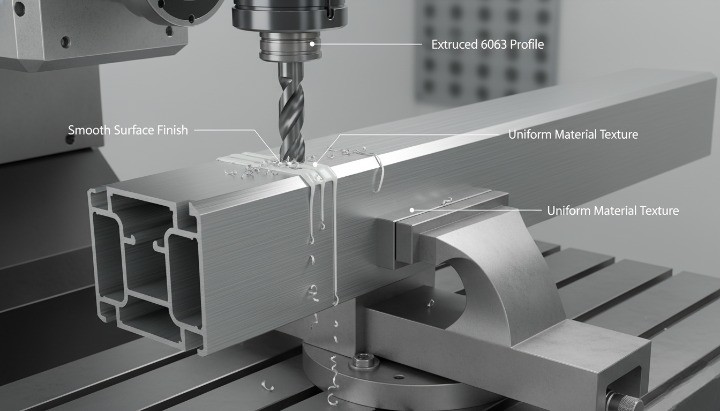
6063 aluminum is widely known as an extrusion alloy and is commonly used when you machine extruded profiles. If your design relies on complex cross-sections with good surface finish, 6063 becomes very relevant to CNC machining aluminium projects.
How 6063 aluminum behaves in CNC machining:
-
Strength: Lower strength than 6061 and 6082, so it suits light-duty structural and non-critical mechanical parts.
-
Surface quality: Excellent surface finish straight from extrusion, which can reduce machining time for cosmetic faces.
-
Machinability: Machines well, especially for secondary operations like drilling, tapping, pocketing, and trimming.
-
Anodizing: Very good anodizing response, ideal for visible, design-driven components.
Where 6063 aluminum is a good fit:
-
Frames, extruded rails, and decorative trims in electronics & consumer products and automation.
-
Lightweight housings, covers, and profiles that need smooth surfaces and consistent appearance.
-
Projects where you prioritize surface finish & cosmetic requirements over maximum aluminum strength.
7075-T6 Aluminum
7075-T6 aluminum is one of the strongest aluminum alloys commonly used for machined parts, with strength approaching some low-alloy steels. When you need extreme performance and weight savings, 7075-T6 is often viewed as the best aluminum for machining in high-load environments.

Key features of 7075-T6 aluminum in CNC machining:
-
Very high strength: Exceptional tensile and yield strength, ideal for demanding aerospace and motorsport components.
-
Machinability: Machines well but is harder on tools than 6xxx alloys, so expect more tool wear and possibly longer cycle times.
-
Corrosion resistance: Lower than 6xxx series; parts usually require protective coatings or anodizing for harsh environments.
-
Fatigue resistance: Strong performance under cyclic loading, useful for dynamic and safety-critical parts.
Typical applications for 7075-T6 aluminum:
-
High-stress parts in automotive racing (suspension components, hubs, steering parts).
-
Structural and flight-critical elements in aerospace and UAV systems.
-
Precision CNC machined aluminum components where weight, stiffness, and aluminum strength are more important than cost.
2024 Aluminum
2024 aluminum is a classic aerospace alloy known for excellent fatigue resistance and high strength. If your design sees repeated loading and unloading, 2024 can outperform many other grades despite some trade-offs.

How 2024 aluminum performs in CNC machining:
-
Strength and fatigue: High strength with outstanding fatigue resistance, ideal for moving or rotating parts.
-
Machinability: Good machinability with sharp tools and correct cutting conditions, especially in CNC milling.
-
Corrosion resistance: Inferior to 6xxx series; usually needs anodizing, alodine, or painting for long-term protection.
-
Weldability: Poor weldability, so it is more suitable for monolithic machined components rather than welded assemblies.
When to choose 2024 aluminum:
-
Aerospace-style components, linkage arms, and structural parts subject to cyclic stresses.
-
High-performance mechanisms in robotics & automation where fatigue life is critical.
-
Cases where you compare 2024 vs 6061 aluminum and favor fatigue strength and stiffness over corrosion resistance and weldability.
MIC-6 Aluminum
MIC-6 aluminum is a cast aluminum tooling plate, engineered for flatness and dimensional stability rather than maximum strength. For precision fixtures, bases, and machine plates, MIC-6 can be one of the most efficient options for CNC machined aluminum.

Characteristics of MIC-6 aluminum in CNC machining:
-
Stability: Excellent dimensional stability with low internal stresses, ideal for tight-tolerance surfaces and large plates.
-
Flatness: Supplied with high flatness and parallelism, which reduces roughing and surfacing time on CNC machines.
-
Strength: Lower mechanical strength than wrought alloys like 6061 or 6082, so it is not a primary structural material.
-
Machinability: Machines easily with smooth chip formation, supporting fine surface finishes for tooling surfaces.

Best use cases for MIC-6 aluminum:
-
Fixtures, jigs, inspection plates, and machine bases in industrial machinery and precision automation.
-
Vacuum plates, router beds, and modular fixturing where stability is more important than the strongest aluminum alloy.
-
Projects focused on repeatable accuracy, where minimizing warpage during machining is a key requirement.
Comparison Table: Properties, Cost, Machinability
The table below compares the main CNC machining aluminum alloys discussed above. Use it as a quick reference when you evaluate the best aluminum for CNC machining for a new project.
| Alloy | Typical Strength Level | Relative Machinability | Relative Cost | Corrosion Resistance | Typical CNC Applications |
|---|---|---|---|---|---|
| 6061-T6 | Medium–high | Easy | Low | Good | General CNC machined aluminum parts, brackets, housings |
| 6082 | High | Medium | Medium | Good | Structural frames, high-load machine components |
| 6063 | Low–medium | Easy | Low | Good | Extruded profiles, cosmetic parts, light-duty components |
| 7075-T6 | Very high | Medium | High | Fair | High-stress aerospace, motorsport, performance mechanisms |
| 2024 | High, high fatigue | Medium | Medium–high | Fair | Aerospace, fatigue-critical robotics and mechanisms |
| MIC-6 | Low–medium | Very easy | Medium | Good | Tooling plates, fixtures, precision machine bases |

6061 vs 6063 vs 6082 vs 7075 — Practical Alloy Selection Framework
Choosing between 6061, 6063, 6082, and 7075 aluminum alloys requires a systematic view of performance, machinability, appearance, and long-term stability. This framework helps engineers and procurement teams select the best aluminum alloy for CNC machining based on measurable engineering factors rather than guesswork.

Strength-Based Selection
Strength is often the first decision-making filter when comparing aluminum alloys. 7075 stands out as the strongest commonly machined aluminum alloy, while 6061 and 6082 serve as general-purpose structural materials. 6063 works best when strength is less critical but cosmetic properties matter more.
• 7075-T6 delivers the highest tensile and yield strength for demanding loads.
• 6082 outperforms both 6061 and 6063, suitable for industrial frames and mechanical structures.
• 6061 offers balanced strength, making it the default choice for general CNC parts.
• 6063 is best for low-stress applications or aesthetic parts requiring premium finishing.
If your design depends on load capacity, stiffness, or impact durability, choosing 7075 or 6082 avoids underperformance and reduces safety risk.
Surface Finish & Cosmetic Requirements
When appearance or anodizing uniformity drives the design, 6063 becomes the preferred alloy for CNC machining. Its fine grain structure produces better cosmetic results compared with 6061 and 6082, especially after anodizing.
• 6063 offers the most consistent, decorative anodized finish.
• 6061 provides respectable cosmetic results but may show slight grain shadows.
• 6082 may produce more visible surface texture after anodizing.
• 7075 anodizes but often yields uneven color due to zinc-rich composition.
For consumer products, electronics housings, and visible parts, 6063 usually provides the best balance of finish quality and machining performance.
Corrosion Resistance & Environmental Conditions
Environmental exposure—moisture, salt, chemicals, or outdoor conditions—should influence alloy selection. The 6xxx series generally provides better corrosion resistance compared with higher-strength 7xxx and 2xxx series alloys.
• 6061 and 6063 offer strong all-round corrosion resistance suitable for outdoor use.
• 6082 performs well in industrial and marine environments due to its magnesium content.
• 7075 is more susceptible to corrosion and should be anodized or coated for long-term exposure.
• 2024, although strong, requires protective treatment for most environments.
For harsh environments, 6061 or 6082 remain the safest CNC machining aluminum choices.
Heat Treatment (T4, T5, T6, T651) Considerations
Heat treatment determines strength, machinability, and dimensional stability. Choosing the correct temper can dramatically impact performance and machining quality.
• T6 provides maximum strength for 6061, 6082, 6063, and 7075 alloys.
• T651 adds stress relief, improving stability during heavy CNC machining.
• T5 is common for extrusion-grade 6063 and offers moderate strength with good finishing quality.
• T4 offers higher ductility for forming before final machining.
For CNC machining aluminum plates or blocks, T6 or T651 is preferred to ensure predictable cutting behavior and minimal warping.
Tolerance & Stability Requirements
High-precision CNC machining requires materials that remain dimensionally stable during aggressive cutting or large material removal. Different aluminum alloys behave differently under thermal load, mechanical stress, and clamping force.
• 6082 and 6061 provide excellent stability for most machined components.
• 7075 holds tight tolerances but may introduce residual stress during machining.
• 6063 may deform in thin-wall cutting due to lower stiffness.
• MIC-6, though not in this comparison group, remains the top choice for flatness-critical plates.
For tolerance-sensitive parts—such as jigs, automated machinery, and robotics frames—choose stress-relieved T651 material or higher-stiffness alloys like 6082 or 7075.

How Different Aluminum Alloys Behave in CNC Machining?
Different aluminum alloys react uniquely under cutting forces, tool engagement, heat buildup, and chip formation. Understanding this behavior helps engineers design parts that machine cleanly, hold tolerances, and avoid unnecessary cost. This section explains how 6061, 6082, 6063, 7075, 2024, and MIC-6 perform inside the CNC mill or lathe, based on real shop-floor behavior—not just data sheets.

Tooling, Cutting Speed & Chip Formation
CNC machining efficiency depends on how each alloy responds to tool contact, cutting heat, and chip evacuation. The wrong alloy choice can increase tool wear, reduce surface quality, or create chatter and vibration.
How each alloy behaves during cutting:
-
6061-T6: Produces short, well-controlled chips; allows high cutting speeds with minimal tool wear.
-
6082: Slightly tougher; requires sharper tools and optimized feeds to avoid built-up edge.
-
6063: Soft and gummy at times; may smear if tools are dull or feeds are too low.
-
7075-T6: Harder alloy generating more heat; benefits from coated carbide tools and controlled chip loads.
-
2024: Cuts cleanly with crisp edges but can erode tools faster due to copper content.
-
MIC-6: Very easy to machine; produces uniform chips and smooth faces even in large-surface operations.
General machinability ranking (best → challenging): MIC-6 → 6061 → 6063 → 6082 → 2024 → 7075
If machining cost is a concern, 6061 and MIC-6 usually provide the fastest machining times with the least tool wear.
Achievable Tolerances by Alloy Type
Dimensional accuracy depends heavily on alloy stiffness, internal stress, and heat treatment. Some alloys expand more under cutting heat or release stress when material is removed.
Typical tolerance expectations in CNC machining:
-
7075: Excellent dimensional stability; holds tight tolerances even on small features.
-
6061 & 6082: Very reliable; suitable for ±0.01 mm tolerances in stable geometries.
-
2024: Holds fine tolerances but requires careful temperature control due to higher heat sensitivity.
-
6063: Soft structure may cause tool deflection; use conservative milling parameters for thin walls.
-
MIC-6: Ideal for precision flatness; maintains plate stability after heavy surfacing.
If your design includes large pockets or thin walls, materials like 6061-T651 and MIC-6 minimize warping and tolerance drift.
Common Machining Issues & Prevention
Each alloy presents unique machining challenges that engineers should consider early in design or DFM discussions. Knowing these issues avoids unnecessary scrap, tool breakage, or finishing rework.
Common problems and mitigation strategies:
-
Built-up edge (BUE): Occurs in 6063 and 6082; solved with sharper tools and higher cutting speeds.
-
Warping or distortion: Common in non-stress-relieved 6061 or 6082; use T651 plates or symmetric part design.
-
Tool overheating: Occurs in 7075 and 2024 due to high heat generation; use coolant and coated carbide.
-
Chatter / vibration: More common in thin-wall parts; reduce step-over and increase tool rigidity.
-
Poor anodizing quality: Seen in 7075 due to zinc; apply Type II or hard anodizing with controlled bath chemistry.
These considerations help teams avoid surprises when moving from prototype to production.
Surface Finishing Compatibility (Anodizing, Powder Coating, Polishing)
Surface finishing requirements often determine which alloy performs best for CNC machined parts. Different aluminum grades anodize, polish, or coat with varying levels of success.
Finishing behavior by alloy:
-
6063: Best anodizing results; clear, consistent color for cosmetic parts.
-
6061: Very good anodizing; widely used for bead-blasted or dyed finishes.
-
6082: Good anodizing but may show minor grain texture on flat surfaces.
-
7075: Hard anodizing improves durability, but cosmetic anodizing may appear blotchy.
-
2024: Lower anodize quality; typically requires alodine or painting.
-
MIC-6: Acceptable for anodizing, but cast structure may show micro-porosity.
If appearance is a priority, 6063 is preferred. If durability is key, 7075 with hard anodizing provides excellent wear resistance.

Cost Factors When Choosing Aluminum Alloys
Material cost influences overall production budgets, but the alloy’s impact on machining time, tool wear, scrap rate, and finishing requirements often matters more than raw material pricing alone. This section explains how 6061, 6063, 6082, 7075, 2024, and MIC-6 differ in cost behavior so engineers and procurement teams can make informed sourcing decisions.

Material Price Differences
Material price varies significantly between common CNC aluminum alloys due to alloying elements, manufacturing methods, and global availability. Understanding baseline pricing helps avoid overspecifying materials where a lower-cost alternative performs equally well.
General price ranking (from lowest to highest): 6063 → 6061 → 6082 → MIC-6 → 2024 → 7075
Price insights that matter during procurement:
-
6061 offers the best cost-performance ratio for most CNC machined parts.
-
6082 is priced slightly above 6061 but may reduce material usage in high-strength designs.
-
6063 is cost-effective for extrusions and cosmetic components.
-
MIC-6 costs more due to precision cast manufacturing but saves machining time.
-
7075 & 2024 carry premium costs driven by aerospace demand and alloying elements.
If budget and performance must both be optimized, 6061 usually provides the strongest value.
Machining Cost Impacts (Cycle Time, Tool Wear)
Regardless of raw material price, machining efficiency often influences the majority of total cost per part. Harder or gummy alloys may require slower feeds, additional tool changes, or more finishing work.
Machining cost characteristics by alloy:
-
6061-T6: Low tool wear, fast cycle times, excellent cost efficiency.
-
6082: Slightly slower cycle times; tools dull faster under high-load cuts.
-
6063: Machines quickly; best for extruded profiles requiring minimal roughing.
-
7075-T6: High tool wear; requires coated carbide or high-performance tooling.
-
2024: Abrasive due to copper; increases tool replacement cost.
-
MIC-6: Very fast milling on large surfaces; reduces surfacing time substantially.
In many projects, machining time savings from MIC-6 or 6061 can outweigh their base material cost advantages, especially for large plates or deep-pocketed designs.
DFM Tips to Reduce Cost
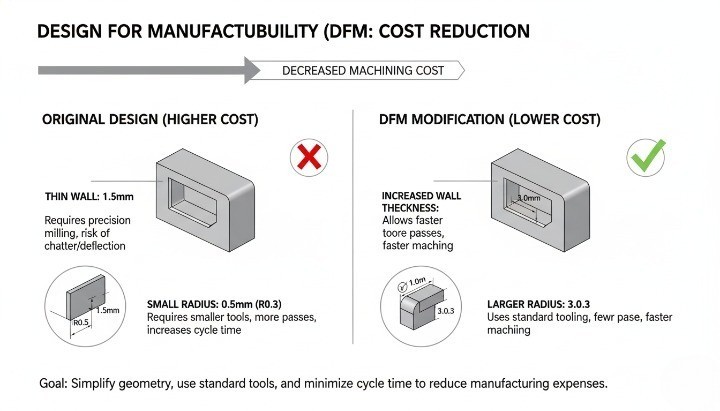
Design for Manufacturability (DFM) plays a major role in controlling CNC machining cost, especially with harder or high-strength aluminum alloys. Small geometry adjustments can significantly reduce cycle time and scrap rates.
Practical cost-reduction strategies:
-
Reduce unnecessary thin walls: Avoid <1.5 mm walls in 7075, 6082, or 2024 to prevent vibration and tool breakage.
-
Use standard stock sizes: Choosing 6061 or MIC-6 in standard plate thicknesses eliminates extra surfacing.
-
Split high-volume parts into modular components: Allows use of lower-cost alloys for non-critical sections.
-
Optimize tool paths for hard alloys (7075, 2024): Adaptive milling reduces heat buildup and tool wear.
-
Choose alloys based on finish needs: Use 6063 only when cosmetic anodizing is essential; otherwise stick to 6061.
-
Prefer T651 over T6 when removing large volumes: Reduces risk of distortion and rework.
These DFM tactics are especially valuable for procurement teams scaling from prototype to mass production.
Industry-Specific Applications
Each industry demands different mechanical, aesthetic, and performance characteristics from CNC machined aluminum alloys. Understanding how 6061, 6063, 6082, 7075, 2024, and MIC-6 aluminum perform in real-world environments helps engineers select materials that align with sector-specific requirements, compliance needs, and long-term reliability.

Automotive
Automotive and motorsport applications prioritize strength-to-weight ratio, fatigue resistance, and consistent performance under vibration and heat. Aluminum alloys reduce weight without sacrificing structural integrity, and CNC machining ensures precision fit within assemblies.
Recommended alloys for automotive parts:
-
7075-T6: Ideal for suspension components, drivetrain parts, hubs, and high-stress structural elements.
-
2024: Excellent for fatigue-loaded components such as brackets, linkages, and steering mechanisms.
-
6061-T6: Common for housings, mounts, brackets, and general structural parts due to cost and versatility.
-
6082: Used in high-strength frames, jigs, and fixtures where stiffness is essential.
Engineers often choose 7075 for the highest-stress areas and 6061 or 6082 for balance between performance and cost.
Robotics & Automation
Robotics applications require a combination of stiffness, machinability, weight reduction, and dimensional accuracy. Precision and repeatability matter more than raw strength alone.
Material choices suited for robotics:
-
6082: Excellent for robotic arms, chassis, linear rail supports, and load-bearing frames.
-
6061: Cost-effective for brackets, housings, sensor mounts, and structural modules.
-
MIC-6: Ideal for precision bases, alignment plates, and machine calibration systems.
-
7075: Chosen for dynamic components subjected to high acceleration and deceleration forces.
Because robotics systems rely heavily on dimensional stability, MIC-6 and 6061-T651 are common for tooling plates and alignment-critical structures.
Electronics & Consumer Products
Electronics and consumer devices prioritize appearance, thermal performance, and precise cosmetic finishing. Anodizing consistency, surface smoothness, and tight assembly tolerances play key roles.
Best alloys for electronics and design-driven products:
-
6063: Preferred for premium anodizing quality and uniform surface finish.
-
6061: Common for enclosures, heatsinks, and mechanical structures that require good strength and cosmetic finishing.
-
MIC-6: Used for jig plates and assembly tooling, not for final consumer products.
Design teams choose 6063 when the visual quality of anodized surfaces defines product identity.
Medical Devices
Medical components require high precision, biocompatibility, and stable machining performance. Consistency and reliability often matter more than maximum strength.
Suitable alloys for medical applications:
-
6061: Widely used due to its clean machining behavior, dimensional stability, and compatibility with coatings and sterilization.
-
7075: Used sparingly for high-strength surgical tools but requires corrosion-resistant finishes.
-
MIC-6: Ideal for fixture plates in medical equipment manufacturing.
Medical device engineers value 6061 for its combination of stability, finishing options, and predictable CNC machining results.
Industrial Machinery
Industrial machinery demands durability, stiffness, and tolerance stability over long production cycles. Large surfaces, precision bases, and structural elements define material choice.
Best alloys for machinery applications:
-
6082: Excellent for high-load structural frameworks, machine arms, and fixtures.
-
6061: Common for general-purpose mechanical parts, guards, housings, and clamping systems.
-
MIC-6: The most stable choice for CNC fixtures, vacuum tables, alignment plates, and measuring systems.
For machine builders, 6082 and MIC-6 cover nearly all structural and precision flatness requirements.

FAQs About Aluminum Alloys for CNC Machining
Clear, specific answers help engineers and procurement teams make confident material decisions. This FAQ section addresses the most common questions about 6061, 6063, 6082, 7075, 2024, and MIC-6 aluminum alloys, focusing on machinability, strength, finishing, and application selection.

What is the best aluminum alloy for CNC machining?
The best overall aluminum alloy for CNC machining is 6061-T6 because it offers the ideal balance of strength, machinability, cost, and surface finishing capability. Engineers choose it for prototypes and mass production because it machines cleanly, supports tight tolerances, and works well with anodizing.
When performance requirements differ, other alloys may be better:
• 7075 for extreme strength
• 6082 for rigid structural components
• 6063 for premium anodizing quality
• MIC-6 for flat, stable precision plates
• 2024 for fatigue-critical components
Across most applications, 6061 remains the strongest value choice for CNC parts.
Which aluminum alloy anodizes best?
If cosmetic appearance matters, 6063 produces the highest-quality anodizing finish. Its microstructure creates smooth, uniform oxide layers ideal for consumer electronics and decorative components.
For structural anodizing, engineers typically select:
• 6061 for balanced strength and finish quality
• 6082 when high strength and good anodizing are needed together
Avoid using 7075 or 2024 for cosmetic anodizing because copper and zinc elements cause uneven color absorption and visible blotching.
Is 6082 stronger than 6061?
Yes, 6082 is stronger than 6061 in yield strength and tensile strength. The difference matters in applications where stiffness or load capacity is critical.
Typical comparison:
• 6082-T6: Higher yield strength and better rigidity
• 6061-T6: More versatile, easier to machine, more widely available
Engineers choose 6082 for structural frames, robotics components, and industrial machinery where performance requirements exceed what 6061 provides.
What alloy is best for high-precision parts?
For high-precision machining, MIC-6 and 6061-T651 deliver the most stable results. Their dimensional stability reduces distortion and enables predictable tolerances even after heavy material removal.
Recommended alloys for precision applications:
• MIC-6: Best for large plates, jigs, fixtures, measuring bases
• 6061-T651: Stable for tight-tolerance mechanical parts
• 6063: Works well for precise cosmetic designs
• Avoid 2024 and 7075 for thin-wall precision parts due to warping tendencies
When accuracy is the top priority, MIC-6 is unmatched for flatness and stability.
Conclusion
Selecting the right aluminum alloy for CNC machining directly affects part performance, machining efficiency, and total manufacturing cost. Alloys such as 6061, 6082, 6063, 7075, 2024, and MIC-6 each bring unique advantages, from strength and fatigue resistance to cosmetic finishing quality and tolerance stability. By understanding alloy composition, machining behavior, and application suitability, engineers and procurement teams can make decisions that support long-term reliability and cost-effectiveness. A structured selection framework—combined with clear knowledge of mechanical needs, finishing expectations, and DFM opportunities—ensures that every CNC machined aluminum part meets both performance and budget targets.
Get Expert Aluminum CNC Machining Support
If you’re sourcing CNC machined aluminum parts or evaluating materials for a new project, our engineering team at HM can help you choose the best alloy and optimize manufacturability. We provide custom CNC machining, aluminum die casting, surface finishing, and assembly, serving industries such as automotive, robotics, electronics, medical devices, and industrial machinery.