
Brass vs Bronze vs Copper: CNC Machining & Application Guide
Selecting the wrong red metal for your CNC parts isn’t just a minor design error—it causes catastrophic component failure. We frequently see electrical connectors overheat because of poor conductivity or marine fittings seize due to saltwater corrosion.
Brass, Bronze, and Copper may look similar, but they perform differently under stress, heat, and machining loads. Mistaking one for the other leads to production delays and expensive scrap.
This guide provides the technical data you need to make an informed procurement decision. We analyze the metallurgical differences, compare machining costs, and define the exact failure risks for each alloy to ensure your project’s success.
Quick Summary for Engineers:
-
Copper (C11000): Best for electrical/thermal conductivity (101% IACS).
-
Brass (C36000): Best for high-speed CNC machining and cost-efficiency.
-
Bronze (C93200): Best for anti-friction, wear resistance, and marine environments.
-
Key Risk: Never use standard Brass in saltwater due to dezincification; always specify Bronze.

Brass vs Bronze vs Copper Properties
Before examining the metallurgy, review this functional breakdown. If you need high-speed production, Brass is the industry standard. If you need maximum conductivity, Copper is essential. For friction and saltwater environments, Bronze is the only safe choice.
| Feature | Copper (C11000) | Brass (C36000) | Bronze (C93200) |
|---|---|---|---|
| Alloy Base | 99.9% Pure Cu | Copper + Zinc (Zn) | Copper + Tin (Sn) |
| Best Application | Electrical & Thermal | High-Volume CNC Parts | Bearings & Marine |
| Machinability | 20% (Difficult/Gummy) | 100% (Standard) | 50% (Moderate) |
| Conductivity | 101% IACS | ~26% IACS | ~15% IACS |
| Tensile Strength | Low (220 MPa) | Moderate (340-480 MPa) | High (240-690 MPa) |
| Corrosion | Good (Patina forms) | Fair (Dezincification risk) | Excellent (Marine) |
| Relative Cost | High | Lowest | Moderate to High |

Industrial Grade Selection Guide
To optimize your CNC project, selecting the specific alloy grade is as vital as choosing the base metal. Each variant offers unique properties for specialized environments.
| Material | Grade (UNS) | Key Characteristics | Typical CNC Application |
|---|---|---|---|
| Copper | C10100 | Oxygen-Free (OFE), 99.99% pure | Vacuum electronics, Semiconductors |
| Brass | C46400 | Naval Brass, high corrosion resistance | Marine hardware, pump shafts |
| Brass | C26000 | Cartridge Brass, excellent ductility | Radiator cores, ammunition |
| Bronze | C95400 | Aluminum Bronze, extremely high strength | Heavy-duty gears, aircraft landing gear |
| Bronze | C51000 | Phosphor Bronze, high fatigue resistance | Electrical springs, diaphragms |

How to Tell the Difference Between Brass and Bronze?
Material test reports (MTRs) are your definitive proof of alloy composition. However, when managing inventory or evaluating , you can identify these alloys on the shop floor using our visual color chart indicators: sight, sound, and chip formation.
Identifying Pure Copper
-
Color: Distinctive reddish-pink or reddish-orange “salmon” hue.
-
Sound: Produces a dull “thud” when struck as the soft metal absorbs energy.
-
Machining Chips: Forms long, stringy “bird’s nests” that are difficult for CNC operators to clear.
Identifying Brass
-
Color: Light, bright yellow, closely resembling gold. High-zinc grades are yellower, while low-zinc “red brass” appears slightly more reddish.
-
Sound: Deeper tone than copper but significantly brighter.
-
Machining Chips: Breaks into small, segmented chips instantly. This is the primary indicator of free-machining C36000 brass.
Identifying Bronze
-
Color: Darker, dull gold or reddish-brown. It often features faint surface rings or a visible textured grain from the casting process.
-
Sound: The “Bell Ring.” Bronze resonates with a clear, lingering tone when struck.
-
Machining Chips: Tougher than brass chips but far more manageable than the gummy strands of pure copper.
Electrical Conductivity and Strength
Material selection often comes down to one critical engineering property. Here is how the alloys compete on conductivity, mechanical load, and environmental resistance.

Why Copper Outperforms Brass?
Copper is the global standard for conductivity (100% IACS). It is mandatory for busbars, motor windings, and high-efficiency heat sinks. Its atomic structure allows electrons to flow with minimal resistance.
Conversely, Brass and Bronze are poor conductors. Brass offers only ~26% IACS, and Bronze drops to ~15%. Using these alloys for primary current transmission creates an electrical bottleneck. Use them for housings or structural support, but never for the conductive path itself.
Is Bronze Harder Than Brass for Heavy-Duty Parts?
Yes, Bronze is generally harder and stronger than Brass. The addition of tin creates a dense lattice structure that resists deformation. This makes it the ideal candidate for heavy-duty bearings and bushings that endure constant friction and high pressure.
Brass is stronger than pure copper but more ductile than bronze. It excels in structural fittings and decorative hardware but will eventually deform under the heavy mechanical loads that bronze withstands with ease.
Marine Grade Bronze vs Brass: Preventing Corrosion
If your project involves saltwater or high humidity, the distinction between these two becomes a matter of safety.
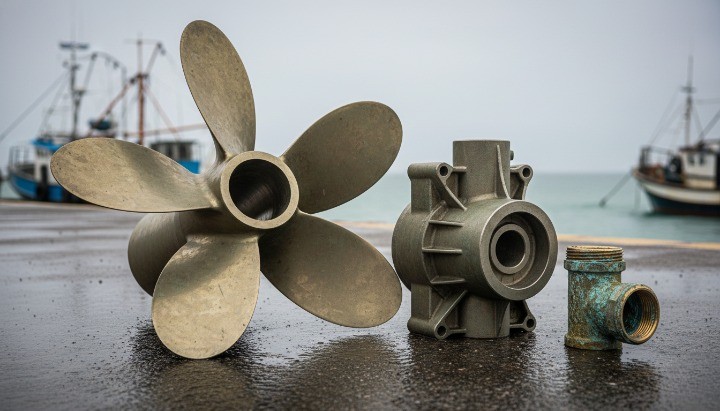
Bronze forms a protective oxide layer that resists deep penetration. According to standards, copper-based alloys are naturally corrosion-resistant, but bronze is the undisputed standard for propellers and submerged maritime fittings.
Brass is vulnerable to dezincification. In saltwater, the zinc is leached out of the alloy, leaving behind a porous, brittle “copper sponge” that snaps under minimal stress. Standard brass should never be specified for critical underwater applications.
Selecting the Right Metal for CNC Machining
To streamline your procurement, here is a definitive summary of the trade-offs for each red metal:
-
Copper (C11000)
-
Pros: Unmatched 101% IACS conductivity; superior thermal dissipation.
-
Cons: High raw material cost; difficult “gummy” machining profile; low structural hardness.
-
-
Brass (C36000)
-
Pros: Fastest CNC cycle times; lowest machining cost per part; excellent aesthetic finish.
-
Cons: Not suitable for saltwater (dezincification risk); lower melting point than bronze.
-
-
Bronze (C93200/C95400)
-
Pros: Extreme wear resistance; self-lubricating properties; marine-grade durability.
-
Cons: More abrasive on CNC tooling than brass; higher weight-to-strength ratio.
-

CNC Machining Strategy: Speeds, Feeds, and Tool Life
For procurement teams and engineers, machinability equals cost. Understanding how these metals interact with cutting tools helps you estimate part prices accurately.
Why C36000 Brass is the King of Speed?
We rate C36000 Brass at 100% machinability. The lead and zinc content act as internal chip breakers, allowing for:
-
Maximum RPMs: Aggressive feed rates without overheating the tool.
-
Extended Tool Life: CNC tools last significantly longer, drastically reducing machine downtime.
-
Economic Value: This is the most cost-effective choice for high-volume screw machine parts.
The Challenge of Machining Pure Copper
Pure copper (C11000) is rated at just 20% machinability. Because it is soft and “gummy,” it tends to stick to the cutting edge, a phenomenon known as Built-Up Edge (BUE). To successfully machine copper, specialized sharp tooling with high rake angles is required.
DFM Tips: Reducing Costs in Copper Alloy Machining
As a specialized CNC facility, we recommend the following design adjustments to minimize scrap rates and tooling costs:
-
Avoid Sharp Internal Corners in Copper: Because pure copper is “gummy,” sharp corners lead to tool vibration. Design with a minimum internal radius of 0.5mm to allow for smoother tool paths.
-
Specify Thread Types Wisely: For Bronze, avoid very fine pitches if possible. Bronze is abrasive and can cause significant wear on small taps.
-
Wall Thickness: Maintain a minimum wall thickness of 0.75mm for Brass and Bronze parts to prevent deformation during high-speed milling.

Application Guide: Validating Your Material Choice
-
High-Current Electrical Connectors: Select Copper (C11000). Maximum efficiency is required to prevent heat-related failure.
-
Underwater Marine Hardware: Select Silicon Bronze. Saltwater destroys standard brass via dezincification; bronze offers decades of service life.
-
High-Volume Fittings & Fasteners: Select Brass (C36000). Rapid machining speeds drive down the unit price for large-scale orders.
-
Heavy Load Bearings: Select Bearing Bronze (C93200). The low friction coefficient prevents seizing under high-stress rotation.

FAQ
What is the price difference between brass, bronze, and copper?
Copper is typically the most expensive due to its purity and global demand. Bronze follows, varying by tin/aluminum content. Brass is the most economical because zinc is significantly cheaper than copper or tin.
Can I weld brass to copper?
Yes, but brazing (silver soldering) is the industry-preferred method. The zinc in brass has a low melting point and can vaporize during welding, compromising joint integrity.
Does bronze rust?
No. Rust is iron oxide, and bronze contains no iron. It oxidizes to form a protective patina, usually dark brown or green (verdigris). This layer acts as a barrier, preventing deep structural corrosion.
Optimizing Your Red Metal Selection
Your choice between Brass vs Bronze vs Copper defines the lifespan and safety of your product. This guide consolidates technical research on bronze vs brass vs copper differences and alloy properties to provide a single resource for engineers.
Don’t let a material mismatch compromise your brand reputation. Ensure your design specifications align with the chemical and mechanical realities of these alloys.
Get Expert CNC Machining Support for Copper Alloys
At HM, we specialize in precision CNC machining for the full spectrum of copper alloys. From high-speed turning of C36000 Brass to complex 5-axis milling of oxygen-free Copper, our facility is equipped to handle the unique tooling requirements of each material.
We provide comprehensive Design for Manufacturing (DFM) feedback to ensure your material choice aligns with both your budget and your performance goals. Our engineering team reviews every drawing to catch potential material failures before they reach production.
Contact us today for a technical design review or a competitive quote on your next project.